Where the rules come from
The rules are the System Reference Document 5.2.1, the free reference version of the 2024 fifth-edition rules, published by Wizards of the Coast under a Creative Commons licence. The SRD is a subset. It is not every rulebook, setting, trademark or piece of artwork.
DungeonFlux is not official Dungeons & Dragons and is not affiliated with or endorsed by Wizards of the Coast.
This work includes material from the System Reference Document 5.2.1 (“SRD 5.2.1”) by Wizards of the Coast LLC, available at dndbeyond.com/srd, licensed under the Creative Commons Attribution 4.0 International License. DungeonFlux is not affiliated with Wizards of the Coast.
How the rules are run
- A rules engine on the server draws the dice and applies the rules listed below. Your phone and the TV show the result.
- The storyteller describes what the dice decided. Its narration cannot change a result.
- When you try something that is not a fixed move, the storyteller picks which skill applies and the server rolls it.
- In a fight, your phone offers the moves that are possible right now.
- Rules are not mixed across editions, and house rules are not presented as standard rules.
What the pilot supports
Early access, draft list. This list comes from a read of the code on 24 October 2026. Each item still has to be confirmed in the tested build before launch, and the list will change as the game does. If this page does not name something, do not assume it works.
Built so far
- Your hero. A level 1 Fighter with the Soldier background and one of the SRD species: Dwarf, Dragonborn, Elf, Gnome, Halfling, Human, Orc or Tiefling. Goliath is in testing (see below). Ability scores come from one of two fixed arrays, and everyone starts with the same fixed equipment.
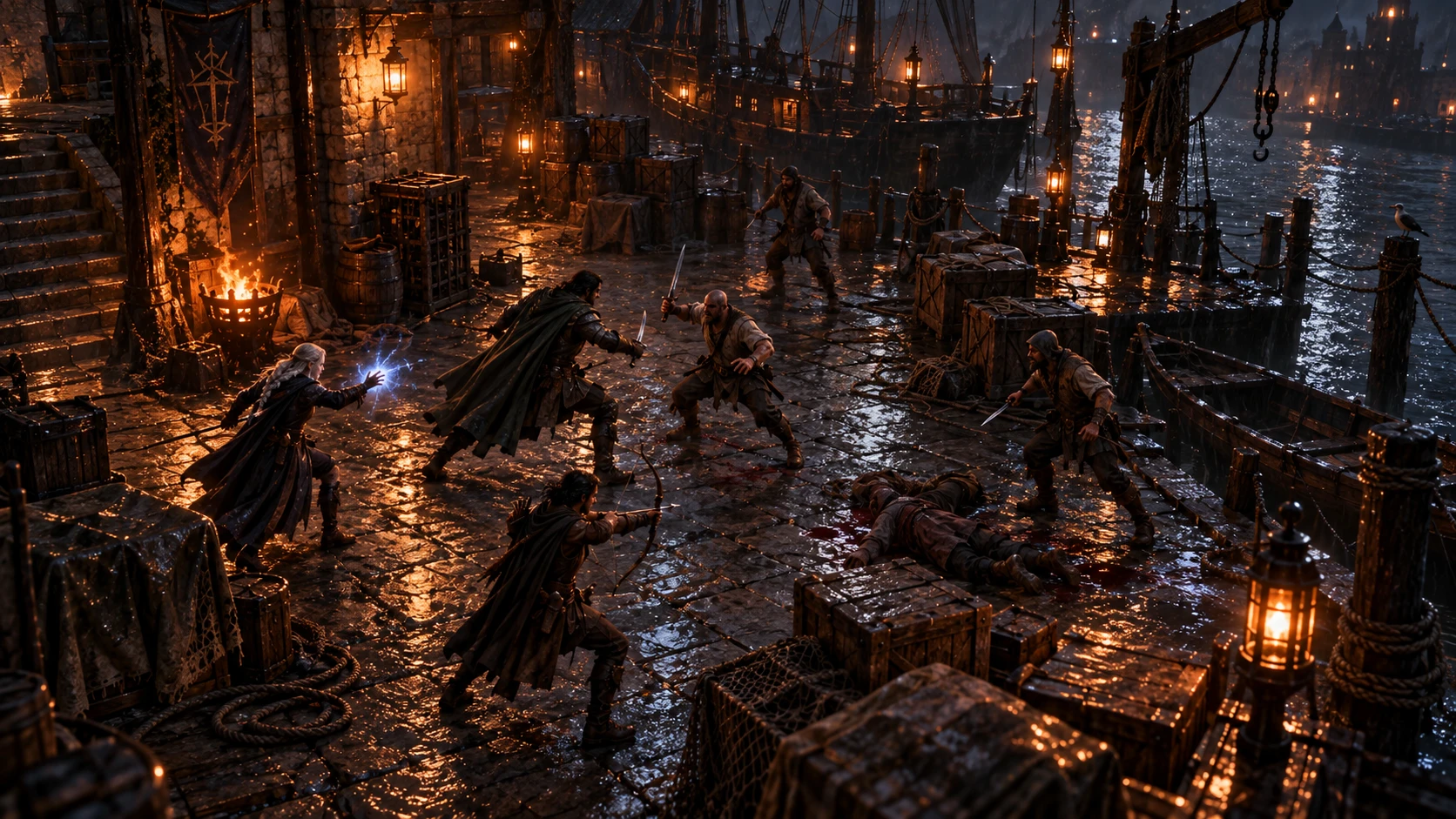
- Fights on a grid. You move, with difficult terrain, crawling and standing up from prone. Each turn gives one action, one bonus action and one reaction. Initiative is a d20 plus Dexterity.
- The moves. Attack (melee reach, ranged distance, cover, advantage and disadvantage, critical hits), Move, Dash, Disengage, Dodge, Stand, Help, Second Wind, Action Surge and opportunity attacks.
- Dying. Death saves, stabilising, and recovering at 1 hit point.
- Ability checks. One d20 plus your modifier and proficiency against a difficulty number. All 18 skills are tied to the right ability.
- Influence checks with people. When a hesitant person is asked to do something, the server rolls a check against DC 15 (or the person’s Intelligence if higher). It is easier when they like you and harder when they are hostile. The storyteller first decides whether the person is willing, and willing people need no roll.
- A short rest after a fight. One hour. You can spend Hit Point Dice to heal, and Second Wind and Action Surge recharge.
Partly built
- Species traits. Working: Dwarf darkvision and Dwarven Toughness, Halfling Luck, Human Tough and Orc Relentless Endurance. Orc Relentless Endurance does not recharge, because there is no long rest. Not working: the Dragonborn breath weapon, Elf, Gnome and Tiefling spells and cantrips, and many smaller traits.
- Backgrounds. Soldier only, with its Savage Attacker feat.
- Dodge. Attacks against a dodging creature have disadvantage. The bonus to Dexterity saves is not used.
- Help. Helping an ally attack and stabilising a dying ally both work. Stabilising does not add Medicine proficiency.
- Weapon masteries. Graze, Sap, Slow, Vex and Nick. Cleave, Push and Topple are not built.
- Conditions. Prone, unconscious, dodging, slowed and sapped, plus the dying states. Other conditions are missing.
- Damage defences. Resistance and vulnerability work only for specific creatures’ attacks, not as a general rule.
- Influence details. A failed attempt is held for the rest of that scene visit, not for 24 hours as the SRD says. A plain lie is a Deception check against a passive Insight. Romance is never rolled.
- Skills. Passive Perception and passive Insight only. No group checks.
- Equipment. Weapons, shields, Healer’s Kit, picking up and dropping weapons, and scene items you can examine, take, steal, buy or give. Armour class is fixed at 17.
- Exploring. Travel between places is narrative. Searches use Perception and a Stealth check at DC 15.
- Experience. The XP for a fight is worked out and shown, but it is not saved or spent.
- Monsters. 17 SRD creatures. Features we have not built are listed in the fight note.
- Dice. The server draws every die in the paths we checked. The TV shows roll rows, and we have not yet confirmed that every roll appears there.
- Departures from the SRD. A few grid rules differ, for example how cover is measured and how initiative ties are ordered. The fight note names the ones it knows about, and that list is not yet complete.
Not built yet
- Spells and cantrips, and spell slots.
- Long rest, and anything that recharges on one.
- Levelling up and spending XP. Fighter levels 2 to 5 exist in the rules engine but players cannot reach them.
- Other classes, other backgrounds and multiclassing.
- Advantage and disadvantage on ordinary ability checks and saves.
- Expertise, and group checks.
- Temporary hit points, and exhaustion.
- Grapple and shove. Hide, Search, Ready and Study as combat actions.
- Most conditions, and resistance and immunity as a general rule.
- Hazards, traps, falling, light and vision rules, and travel pace.
- Armour choice, magic items, attunement and carrying capacity.
In testing
- Goliath. It is on the species list, but its Stone’s Endurance and Storm’s Thunder ancestries are not listed as supported. We are checking whether they can stop a fight from moving on. Until that is settled, do not count on a Goliath hero.
What we do not claim
- Full coverage of the 2024 rules. Broader coverage is a goal for later releases, not a claim about the pilot.
- Material outside the SRD, such as content from other rulebooks, settings or published adventures.
- Any particular party size, response speed or uptime beyond what we have tested and state on this page.
Adventures, party size and content
The pilot is planned around one well-tested adventure or bounded free-roam experience. Two to six players is the design target. The largest party we have tested will be stated here, and the pilot will not be offered at a size we have not tested.
DungeonFlux launches as an adult service. The content rules are in the content policy draft.
Browser and device requirements are on the help page.